
Blog
Why One Health Needs Non-Animal Methods at the Core of Its Mission

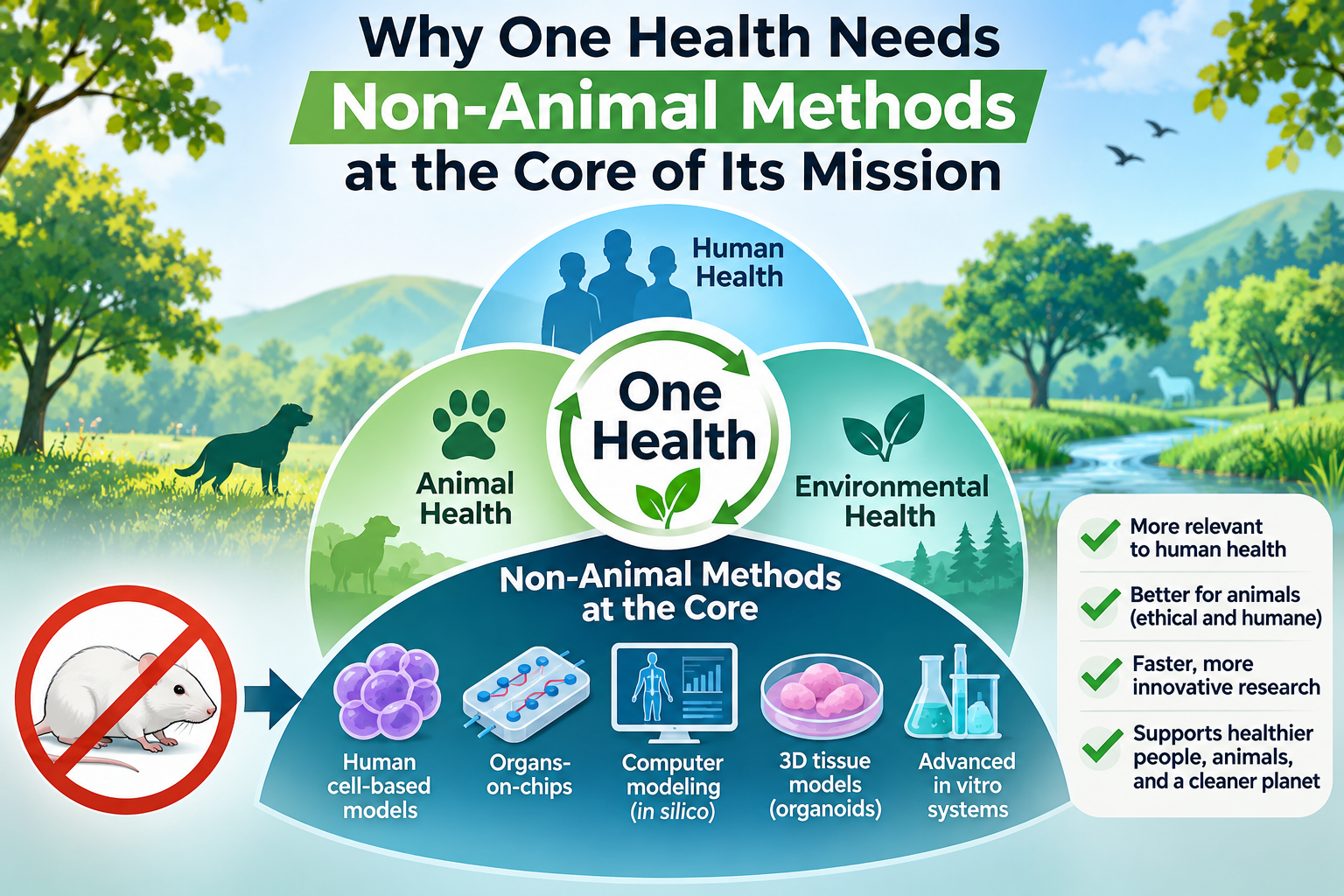
One Health recognises that human health, animal health and the environment are interconnected. But how can this paradigm claim to protect these connections while continuing to exploit animals in scientific research, commercial industries and international trade? Ending animal testing and advancing human-relevant, non-animal methods must become central to the One Health agenda.
By Savita Nutan, Founder of Medicine Without Cruelty
One Health cannot be built on animal exploitation
One Health is founded on a fundamental principle: the health of humans, animals and the environment cannot be considered in isolation. Our health depends on functioning ecosystems, healthy animal populations and responsible relationships with the natural world.
Yet there is a significant contradiction within the way One Health is understood and implemented. While governments, international organisations and research institutions increasingly recognise the importance of interconnected health, animal exploitation remains deeply embedded in scientific research, commercial industries and international trade.
Animals are bred, captured, transported, experimented on and killed on an enormous scale. Their exploitation is frequently treated as a series of separate issues: laboratory testing, wildlife trafficking, the dog and cat meat trade, animal racing or commercial breeding. But these practices are connected by systems that treat animals as commodities and sustain demand for their continued exploitation.
The consequences extend beyond the animals themselves. Animal experimentation raises fundamental questions about the scientific validity of using other species to predict human biology. International animal trade can create opportunities for infectious diseases to cross borders. Wildlife capture and exploitation can disrupt ecosystems and biodiversity. The movement of animals through commercial supply chains also creates occupational health risks for the people involved.
These are not unrelated concerns. They are precisely the kinds of interconnected challenges that a genuine One Health approach should address.
If One Health is to fulfil its purpose, it must move beyond managing the consequences of animal exploitation. It must address the systems that create them.
The scientific problem: other species are not reliable proxies for human biology
Animal testing continues to be used across medical research, drug development, toxicity testing, education and other areas of science. Its continued use is often justified on the grounds that animals provide an essential safeguard before treatments are tested in humans.
However, the fundamental scientific problem remains: animals are not humans.
Different species have distinct genetic, physiological, immunological and metabolic characteristics. These differences influence how diseases develop, how drugs are absorbed and metabolised, how immune systems respond and how biological processes interact.
Even within a single species, genetic and physiological variation can produce substantial differences in responses to drugs and treatments. Research has demonstrated variation in the metabolism of medicines between different dog breeds, including differences in the way greyhounds process anaesthetic agents and genetic variation affecting the metabolism of certain anti-inflammatory drugs.
If biological responses cannot reliably be generalised even between members of the same species, we must question the assumption that results obtained from another species can consistently predict human outcomes.
The problem is particularly significant in drug development. Approximately 95% of drug candidates entering clinical trials fail to receive approval, although failure rates vary according to therapeutic area, development stage and how success is defined. These candidates have already passed preclinical assessments, which frequently include animal studies.
This does not mean that animal testing alone accounts for every subsequent failure. Clinical trial failures can arise from a range of factors, including insufficient efficacy, unexpected toxicity, inappropriate dosing and differences between study populations. However, the scale of attrition demonstrates that existing preclinical approaches do not reliably identify which candidates will succeed in humans.
There are also well-known examples of serious human harm despite reassuring animal data.
The TGN1412 clinical trial in 2006 resulted in six healthy volunteers developing severe systemic inflammatory reactions and multiple organ failure after receiving the experimental antibody. Earlier animal studies had not adequately predicted the severity of the human response.
Such cases demonstrate why biological differences matter. A method that produces a reassuring result in another species cannot automatically be considered a reliable indicator of safety in people.
This is a scientific, ethical, practical and global public health issue. Human health requires research methods capable of investigating human biology.
Human-relevant science is already available
The scientific landscape has changed considerably. Researchers now have access to an expanding range of non-animal methods that can investigate human biology directly.
These include:
- Human cells and tissues: enabling researchers to study human-specific biological processes, disease mechanisms and responses to drugs.
- Organoids and three-dimensional models: creating structured models of human tissues and aspects of organ function.
- Organ-on-chip technologies: using engineered systems to reproduce selected features of human organs and their interactions with drugs and other exposures.
- Computational methods and artificial intelligence: helping researchers analyse biological information, identify patterns and predict potential responses.
- Omics technologies: including transcriptomics, proteomics and metabolomics, which allow researchers to investigate changes in gene expression, proteins and metabolites across complex biological systems.
- Integrated approaches to testing and assessment: combining different sources of evidence to build a more comprehensive understanding of biological effects.
These approaches can be used individually or in combination. For example, human cell models can be integrated with computational analysis and molecular profiling to investigate how a treatment affects multiple biological pathways.
The aim is not simply to create another laboratory model. It is to develop a research system centred on human biology, using methods that are scientifically relevant to the questions being investigated.
Importantly, non-animal methods are not merely technologies for the future. They are already being used right now in research, drug development and safety assessment, and animal tests have already been eliminated from specific applications.
The challenge is to accelerate their development, validation and adoption, while ending institutional and regulatory dependence on animal experimentation.
The economic and scientific opportunity
The case for human-relevant science is also an economic one.
A 2022 study by Ewart and colleagues assessed the performance of a human Liver-Chip in predicting drug-induced liver injury. The study reported 87% sensitivity for the Liver-Chip model in its assessment.
The researchers also examined the potential economic implications of wider organ-chip adoption. Their analysis estimated that applying organ-chip technologies across major causes of clinical trial failure could generate substantial annual improvements in drug-development research and development productivity.
The modelled estimate was approximately $3 billion in potential annual productivity gains from the Liver-Chip application alone, rising to more than $24 billion if additional organ-chip models were developed and applied across other major causes of clinical attrition.
These figures are projections, nevertheless, they illustrate the economic value of investing in technologies designed around human biology.
This raises an important question about research priorities. If human-relevant methods can provide valuable information about human disease and drug responses, why does so much funding continue to support animal experimentation?
Investment decisions shape the direction of scientific progress. Funding must be directed towards developing and implementing human-relevant methods, rather than perpetuating research systems that rely on other species as proxies for people.
In October 2025, an important milestone was achieved in the use of human organoid technology in oncology drug development. The US Food and Drug Administration (FDA) cleared an Investigational New Drug (IND) application for an oncology combination therapy, BAL0891 with the immune checkpoint inhibitor tislelizumab, following the use of human vascularised organoid data to generate the key preclinical efficacy evidence. The work involved biotechnology company Qureator and pharmaceutical company SillaJen, using Qureator’s vascularised tumour immune microenvironment (vTIME) platform, which combines human tumour organoid models with vascular and immune components.
What makes this development particularly significant is that the efficacy evidence supporting the application was generated using human-relevant organoid technology without traditional animal proof-of-concept efficacy studies. It represents a major milestone in demonstrating that human-based models can contribute directly to regulatory submissions for new medicines. Importantly, this was clearance of an investigational application, not approval of the drug for general clinical use. Nevertheless, it provides a tangible example of how drug development can progress using human-relevant science rather than relying on animal experiments as an assumed prerequisite.
One Health and the international animal supply chain
The connection between animal exploitation and One Health becomes particularly apparent when we examine international animal supply chains.
The use of non-human primates in research, for example, is supported by international networks involving capture, breeding, transport, export and import. These systems raise questions about wildlife protection, traceability, infectious disease and occupational exposure.
In 2022, US prosecutors brought a case alleging that wild-caught macaques from Cambodia had been misrepresented as captive-bred and routed through breeding facilities before export to the United States. The case highlighted concerns about the origins of animals entering international research supply chains and the potential for wildlife laundering.
The public-health implications are also important.
In 2023, an outbreak of Mycobacterium orygis, a bacterium belonging to the tuberculosis complex, was identified in a shipment of 540 macaques imported into the United States from Southeast Asia. The US Centers for Disease Control and Prevention reported that 26 animals were confirmed infected. No associated human cases were identified in that particular outbreak.
This importance of this cannot be understated. Tuberculosis is a recognised zoonotic risk associated with non-human primates, particularly for people involved in their handling, transport and care.
Another example illustrates the potential seriousness of occupational exposure. In China, a veterinary surgeon working at a primate breeding and research institute died from B virus infection after performing post-mortem examinations on two macaques.
These cases demonstrate different dimensions of the same wider problem: the movement of animals through international research supply chains can involve wildlife exploitation, infectious disease risks and potentially fatal occupational exposure.
A genuine One Health response must recognise these connections. It should not focus solely on improving the management of animal supply chains while allowing the demand that sustains them to continue.
The long-term solution is to end animal experimentation and the commercial systems built around supplying animals for laboratories.
Animal exploitation does not begin and end in laboratories
Animal exploitation is not confined to scientific research. Animals can move between different industries, and the systems that breed, trade and exploit them often share similar assumptions about their value and purpose.
The commercial dog and cat meat trade in Southeast Asia provides one example. A Four Paws investigation documented a trafficking route through Vietnam spanning approximately 1,704 kilometres and taking around 34 hours. Investigators reported observing a truck carrying an estimated 300–400 dogs. Police stopped the vehicle, but no checks were carried out and the journey continued.
Long-distance transport and poorly monitored animal movements raise serious questions about animal suffering, enforcement, traceability and disease-control measures.
In Queensland, Australia, another disturbing connection has been reported between the greyhound racing industry and research laboratories. The Coalition for the Protection of Greyhounds has highlighted the disappearance of almost 1,000 greyhounds into research laboratories and universities over a five-year period, based on its analysis of industry records.
These examples concern different industries and different circumstances. They should not be treated as identical practices. But they demonstrate how animals can be bred for one commercial purpose and subsequently channelled into another system when they are no longer wanted.
This is why addressing animal exploitation requires more than responding to individual incidents. We must examine the industries, commercial incentives and supply chains that sustain it.
Efforts to address infectious disease, protect biodiversity and improve animal populations cannot be fully effective while the underlying systems of exploitation continue unchecked.
Prevention must address the source of the problem.
Policy must match scientific progress
Scientific progress alone will not end animal testing. Governments, regulators, funding bodies and educational institutions must create policies that enable human-relevant methods to become the foundation of research and safety assessment.
There are encouraging developments internationally. In 2025, the World Health Organization issued guidance addressing the use of non-animal methods in the quality control of biological products where appropriate. In the United States, legislative and regulatory developments have also sought to advance the use of human-relevant methods in drug development.
A further milestone was reported in October 2025, when an oncology Investigational New Drug application was cleared using efficacy data generated with human vascularised organoids, without traditional animal efficacy studies. This was a regulatory milestone involving an investigational application, not the approval of a drug for general clinical use. Nevertheless, it illustrates how human-relevant models can contribute to real regulatory submissions.
However, progress in individual applications should not be confused with the end of animal testing. A clear direction of travel is needed.
The policy challenge is particularly evident in India, where draft rules published in October 2026 concerning the control and supervision of animal experimentation, breeding and trade raised significant concerns about animal sourcing and institutional oversight.
The proposals include provisions relating to the sourcing of wild and stray animals and the approval of certain categories of experiments through institutional committees. These provisions warrant close scrutiny, particularly in relation to wildlife protection, traceability, disease risks and the future direction of scientific education.
It is contradictory to promote modern science and interconnected health while retaining frameworks that allow animal experimentation to continue without a clear, binding transition towards human-relevant methods.
Governments should establish national roadmaps to end animal testing, with legally binding timelines, measurable milestones, enforceable obligations and sustained investment in non-animal science.
They must also address the breeding of animals for experimentation and establish appropriate veterinary care, rehabilitation, adoption or lifelong sanctuary for animals leaving laboratories.
The science is advancing. Policy must catch up.
Education: changing the future of science
Perhaps the most important part of this transition is education.
The next generation of scientists, healthcare professionals, researchers and policymakers must be equipped with the knowledge and skills to work with human-relevant methods. Yet students can still be taught within scientific frameworks that present animal experimentation as an unavoidable or essential part of research.
Education must move beyond simply explaining how animal experiments are conducted. It must critically examine their scientific limitations, the ethical implications of animal exploitation and the non-animal technologies already available.
At Medicine Without Cruelty (MWC), our work is built around this principle.
Through the Stop & Use Non-Animal Methods (SUN) Project, we are developing educational resources and courses for colleges and universities that explain why animal testing must end and introduce students to modern non-animal science.
Our work includes guest lectures, school and university engagement, educational materials and the development of accessible online learning. We want students and educators to understand not only the scientific limitations of animal testing but also the opportunities offered by human cells and tissues, organoids, organ-on-chip systems, computational approaches and other non-animal methods.
This work must extend internationally. Scientific education should not be restricted by geography or institutional resources. We need partnerships between universities, colleges, researchers and animal-protection organisations to make high-quality education on non-animal science accessible to students around the world.
Compassion and scientific progress should not be treated as competing priorities. A modern education system can teach respect for animal life while equipping students with the scientific knowledge to advance human health without animal experimentation.
Three pillars for a genuine One Health strategy
At Medicine Without Cruelty, we believe that education, health and protection must be treated as interconnected priorities.
Education: Teach compassion from an early age, embed non-animal methods in scientific curricula, and train researchers in human-relevant science.
Health: Advance non-animal methods to improve the relevance of research, support human health and protect the interconnected health of people, animals and ecosystems.
Protection: Establish binding roadmaps to end animal testing, stop the trafficking and commercial exploitation of animals, end the dog and cat meat trade, and address industries that continue to breed and exploit animals.
These priorities cannot be pursued independently. Education enables scientific change. Human-relevant science supports better approaches to health research. Protection requires policies that address the systems sustaining exploitation.
A One Health strategy that ignores any of these dimensions will remain incomplete.
It is time to stop it at the source
One Health offers an important opportunity to rethink our relationship with animals and the natural world. But that opportunity will be lost if the concept is reduced to managing disease risks while leaving the underlying systems of exploitation untouched.
We cannot claim to protect human health while relying on methods that do not reliably predict human biology. We cannot claim to protect biodiversity while allowing wildlife to be captured and channelled into commercial supply chains. And we cannot claim to recognise the interconnectedness of life while continuing to treat animals as resources for scientific and commercial use.
Ending animal testing is not a rejection of scientific progress. It is a demand for science to move forward.
Human-relevant, non-animal methods are already available. The responsibility now lies with governments, regulators, research institutions, funding bodies and educators to accelerate their adoption and commit to ending animal experimentation.
A genuine One Health approach must protect human health, respect animal lives and safeguard the ecosystems on which we all depend.
One Health cannot be built on animal exploitation.
End animal testing. Advance non-animal methods.
References and further reading
- Bailey, J., Thew, M. and Balls, M. (2014). An analysis of the use of animal models in predicting human toxicology and drug safety. Alternatives to Laboratory Animals, 42(3), 181–199. https://doi.org/10.1177/026119291404200306
- Ewart, L., Apostolou, A., Briggs, S.A. et al. (2022). Performance assessment and economic analysis of a human Liver-Chip for predictive toxicology. Communications Medicine, 2, Article 154. https://doi.org/10.1038/s43856-022-00209-1
- Garner, J.P. (2014). The significance of meaning: Why do over 90% of behavioral neuroscience results fail to translate to humans, and what can we do to fix it? ILAR Journal, 55(3), 438–456. https://doi.org/10.1093/ilar/ilu047
- Marshall, L.J., Bailey, J., Cassotta, M., Herrmann, K. and Pistollato, F. (2023). Poor translatability of biomedical research using animals: A narrative review. Alternatives to Laboratory Animals, 51(2), 102–135. https://doi.org/10.1177/02611929231157756
- Paulson, S.K. et al. (1999). Evidence for polymorphism in the canine metabolism of the cyclooxygenase 2 inhibitor, celecoxib. Drug Metabolism and Disposition, 27(10), 1133–1142. https://pubmed.ncbi.nlm.nih.gov/10497139/
- Sams, R.A., Muir, W.W., Detra, R.L. and Robinson, E.P. (1985). Comparative pharmacokinetics and anesthetic effects of methohexital, pentobarbital, thiamylal, and thiopental in Greyhound dogs and non-Greyhound, mixed-breed dogs. American Journal of Veterinary Research, 46(8), 1677–1683. https://pubmed.ncbi.nlm.nih.gov/4037494/
- Home Office (2026). Scientific procedures on living animals, Great Britain: 2025. UK Government. https://www.gov.uk/government/statistics/scientific-procedures-on-living-animals-great-britain-2025
- UK Government (2025). Replacing animals in science: A strategy to support the development, validation and uptake of alternative methods. https://www.gov.uk/government/publications/replacing-animals-in-science-strategy
- FOUR PAWS International (2024). Highway to Hell: The Illegal Trade of Dogs and Cats Through Hà Tĩnh Province, Vietnam. Report
- US Centers for Disease Control and Prevention (2024). Outbreak of Mycobacterium orygis in a Shipment of Cynomolgus Macaques Imported from Southeast Asia — United States, February–May 2023. MMWR.
- US Department of Justice (2022). Case and prosecution materials concerning the alleged illegal importation and misrepresentation of wild-caught macaques from Cambodia.
- China CDC Weekly (2021). Report concerning fatal occupational B virus infection in a veterinary surgeon following exposure to macaques.
- Government of India (2026). Draft Prevention of Cruelty to Animals (Control and Supervision of Experiment, Breeding and Trading of Laboratory Animals) Rules, 2026. Gazette of India, October 2026.